Antique Postcard Tacoma: The Stadium High School Bowl
Geographic description:
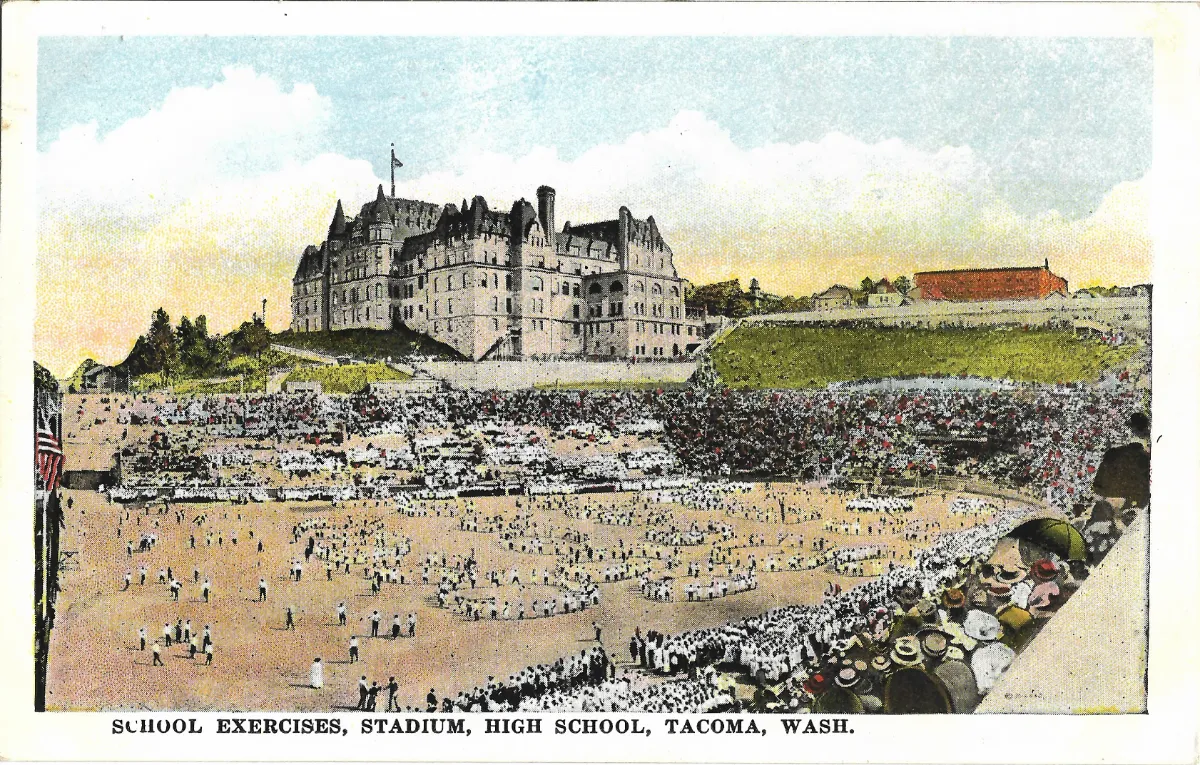
This antique postcard Tacoma offers a sweeping view down into the Stadium Bowl, the open-air amphitheater built into a natural ravine below the main building of Stadium High School, in Tacoma, Washington. The printed caption at the bottom of the card, “SCHOOL EXERCISES, STADIUM, HIGH SCHOOL, TACOMA, WASH.”, unambiguously confirms the location and identifies the scene as a school exercise or pageant taking place within the stadium grounds attached to the school.
Dominating the composition is the school’s massive stone main building, built in the French Châteauesque style and instantly recognizable by its corner turrets, steep-pitched dormers, tall chimneys, and a flagpole flying an American flag. Perched on a rise above the natural bowl, the building’s silhouette matches precisely the known hilltop siting of Stadium High School overlooking Commencement Bay and Puget Sound, although the water itself is not visible in this view, which is framed tightly on the stadium.
The foreground, occupying most of the image, shows the sloped terraces of the Stadium Bowl packed with spectators — several thousand people seated or standing on the grassy embankments and bleacher structures. At the center of the field, groups of students dressed uniformly in white appear to be performing coordinated drills or formations, suggesting a gymnastics demonstration, a parade, or an end-of-year school ceremony. The American flag visible at the left edge of the image, together with the uniform white attire worn by most participants, supports the hypothesis of an official, festive school event.
In the background to the right of the main building, residential rooftops are visible, including one prominent red roof, suggesting a nearby residential neighborhood consistent with the school’s location in Tacoma’s historic North Slope district. The sparse vegetation on the stadium slopes and the still-young trees near the building suggest landscaping that was relatively recent compared to the construction of the main building itself.
Historical description:
Historically, the identification of the building is not in doubt: this is Stadium High School in Tacoma, a structure with a particularly eventful and well-documented history. Construction began in 1891 under architects Hewitt and Hewitt, commissioned by the Northern Pacific Railroad Company and the Tacoma Land Company to build a luxury hotel modeled on the châteaux of the Loire Valley. The financial Panic of 1893 abruptly halted construction while the building shell was already largely complete, leaving it unfinished for several years. The building was then used as a lumber and shingle warehouse by the railroad company before being gutted by fire in 1898.
Purchased by the Tacoma School Board in 1904, the building was converted into a school under the direction of local architect Frederick Heath, who preserved the château-style exterior while redesigning the interior. The school reopened on September 10, 1906, as Tacoma High School. The Stadium Bowl, the amphitheater shown in the foreground of this card, opened in 1910, a decisive chronological marker for dating this postcard, since the scene depicted cannot predate that year. The school was not renamed Stadium High School until 1913, following the opening of Lincoln High School; the caption on this card, which reads “STADIUM, HIGH SCHOOL” without clearly using that compound name, does not allow a firm distinction between a purely descriptive label and the official name adopted after 1913.
Without access to the reverse side of this antique postcard Tacoma, no postmark, stamp, or handwritten annotation can be examined to refine the dating, and this methodological limitation should be stated clearly. Examination of the card’s physical format — a white border framing the image, hand-tinted coloring applied over a black-and-white photograph, and print quality typical of American tourist view-cards — points toward a production window of roughly 1910 to 1925, a broad range that remains a reasonable hypothesis rather than a certainty. The scene itself, with thousands of students gathered in white uniforms for what resembles a gymnastics demonstration or an end-of-year school ceremony, possibly an annual “Play Day” or field day, a common practice in large American high schools of the early twentieth century, documents a well-attested social use of the Stadium Bowl as a community gathering place, well beyond athletic competitions alone. The identity of the card’s publisher remains undetermined: no legible printer’s mark or collection number appears on the front of the card, which is common for postcards of this type mass-produced for the local tourist market.