Antique Postcard Riverside Drive New York Playgrounds
Geographic description:
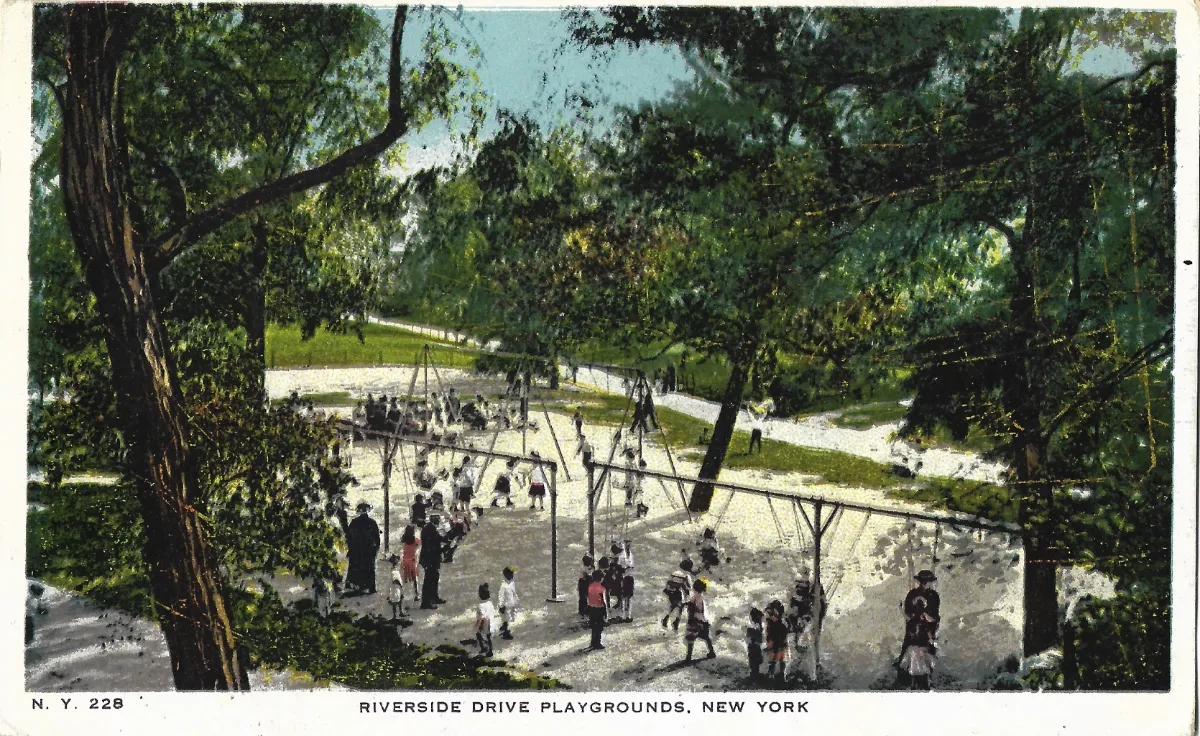
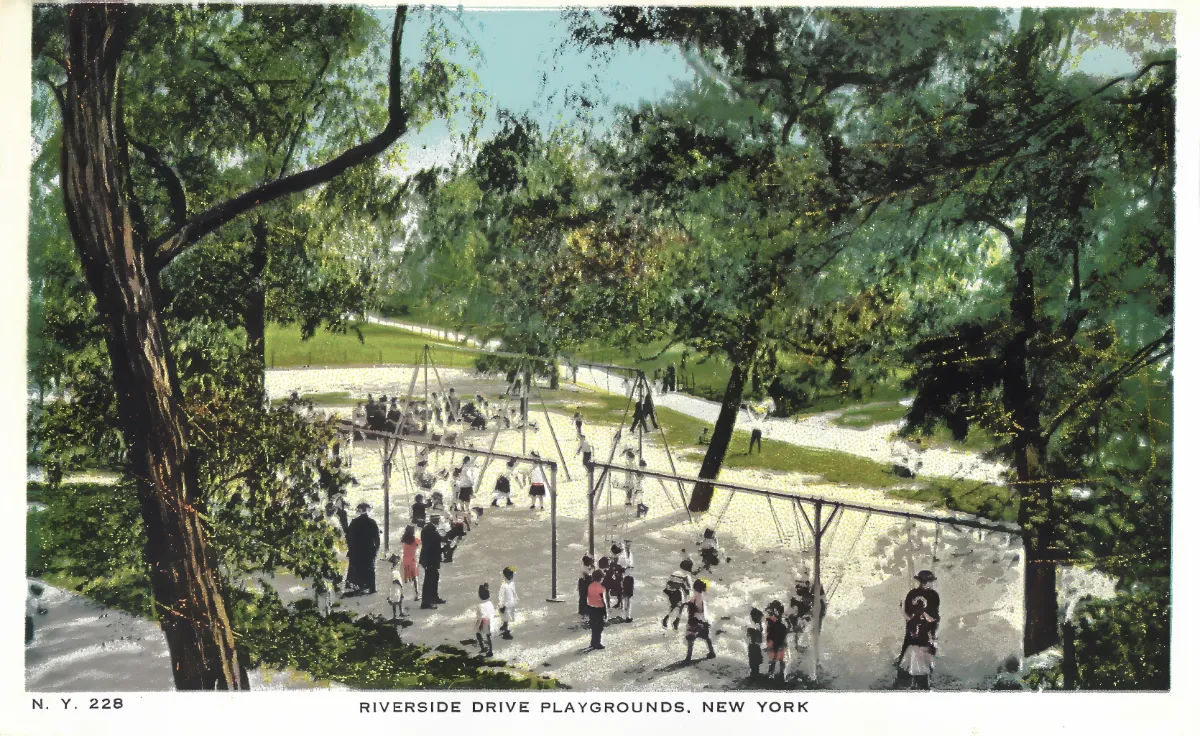
This antique postcard Riverside Drive New York captures a park playground photographed from a slightly elevated vantage point, framed through a dense curtain of summer foliage. Two large tree trunks anchor the foreground: a broad one on the left that occupies much of the frame’s edge, and a slimmer one on the right, both fully leafed out, suggesting the original photograph was taken in spring or summer. Between them opens a fenced-off play area equipped with several metal swing frames, on which numerous children can be seen in motion, while others appear gathered around a see-saw or a group activity further back on the sloping lawn. The playground’s light-colored ground surface, likely packed sand or fine gravel, is consistent with early twentieth-century American playground design, intended to cushion falls from swings and see-saws.
In the background, a gently sloping lawn bordered by a low fence and a winding path suggests a larger landscaped park extending beyond the immediate play area. This layout, with its rolling lawns, mature trees, and curving paths, is characteristic of the English landscape-garden style favored in major American urban parks designed in the second half of the nineteenth century.
Roughly thirty figures can be counted across the scene: children of varying ages, some actively swinging, and adults, mostly women, standing or conversing at the edges of the play area in what reads as a supervisory role. This ratio of accompanying adults to children matches the typical use of public playgrounds of the period, often visited by family groups or neighborhood children under the watch of a mother, nursemaid, or older sibling.
The caption printed along the bottom of the card reads “RIVERSIDE DRIVE PLAYGROUNDS, NEW YORK,” which firmly establishes the general subject: a playground located near Riverside Drive, the avenue running along Manhattan’s Upper West Side above the Hudson River. This is very likely one of the play areas within Riverside Park, the public park bordering the drive for several miles. The card does not, however, allow for a precise identification of which specific playground within the park is shown, nor the cross street nearest to it; a more precise location would require checking municipal archives or postcard collections indexed by street number. A publisher’s number, “N. Y. 228,” appears in the lower left corner, most likely a series number used by the card’s publisher to organize a set of New York views, though the publisher’s name itself is not legible on the recto and therefore remains undetermined without the verso.
Historical description:
The printing style of this antique postcard Riverside Drive New York, with its white border framing the color image, corresponds to the so-called “white border era” of American postcard production, generally dated between roughly 1915 and 1930. This is a stylistic observation and therefore a probabilistic dating indicator: it does not by itself pin down a precise year, but it reasonably rules out production before 1915 or after 1930.
Clothing provides a second, converging set of clues. The children wear short garments, knee-length shorts or dresses, several paired with tall socks, a silhouette typical of childhood dress in the 1910s and 1920s. The adults, particularly the women visible in the background, wear long dark coats paired with relatively wide-brimmed hats; this silhouette is more consistent with the mid-1910s than with the slimmer, closer-fitting fashions that emerged in the early 1920s. Combining this clothing evidence with the white-border printing format, the most reasonable hypothesis places the original photograph between roughly 1915 and 1922, with a moderate degree of confidence: this remains a probability range rather than a certainty, in the absence of any external dating evidence.
No verso has been provided for this card: there is no postmark, stamp, or handwritten note available to confirm or refine this stylistic dating hypothesis. This absence is a methodological limitation worth stating explicitly: the date proposed here rests solely on analysis of the recto and would ideally be cross-checked against a mailed example of the same view, or against the publisher’s catalogue corresponding to the number “N. Y. 228,” should that publisher be identified through other means.
On the broader historical record, it is well established that Riverside Park was laid out beginning in 1872 to an original plan by landscape architect Frederick Law Olmsted, with an initial footprint of about 191 acres between 72nd and 125th Streets in Manhattan; this is a verified fact, independent of the image analysis itself. Available sources further indicate that a much larger improvement program, carried out under Parks Commissioner Robert Moses between 1935 and 1941, added several new playgrounds and sports facilities to the park, notably by covering the railroad tracks that had previously run along the riverbank. If the proposed dating of roughly 1915-1922 is accepted, this antique postcard Riverside Drive New York would therefore depict a playground predating that major 1930s program: several period photographic sources from the First World War era confirm that Riverside Park already contained children’s play equipment comparable to what is shown here, even if fewer in number than the facilities added later.
More broadly, this type of playground reflects the early twentieth-century American social movement favoring supervised recreational spaces for children in dense cities, championed by urban reform groups seeking to offer families in crowded Manhattan neighborhoods a safer alternative to street play. Sold to tourists and residents alike, the card indirectly illustrates this shift in municipal recreation policy, though the image alone cannot clarify further how this particular example was used or mailed.