Antique Postcard Prospect Park: The Colonnade, Brooklyn
Geographic description:
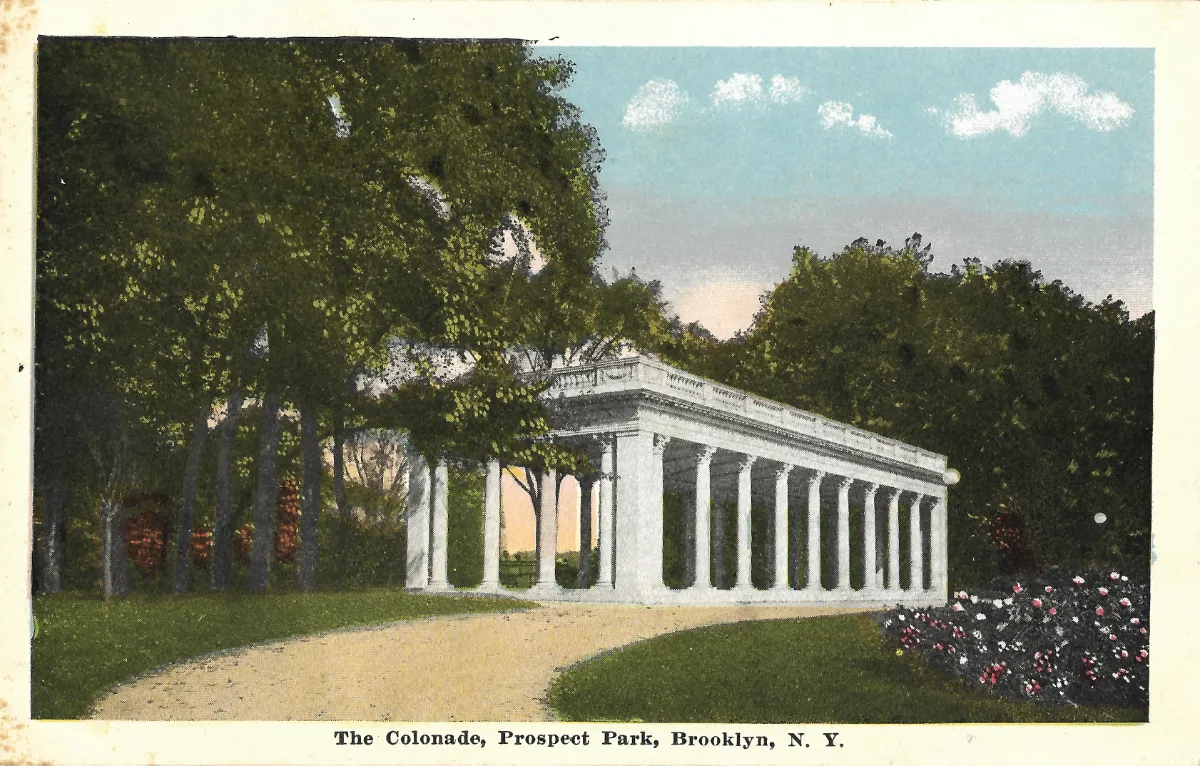
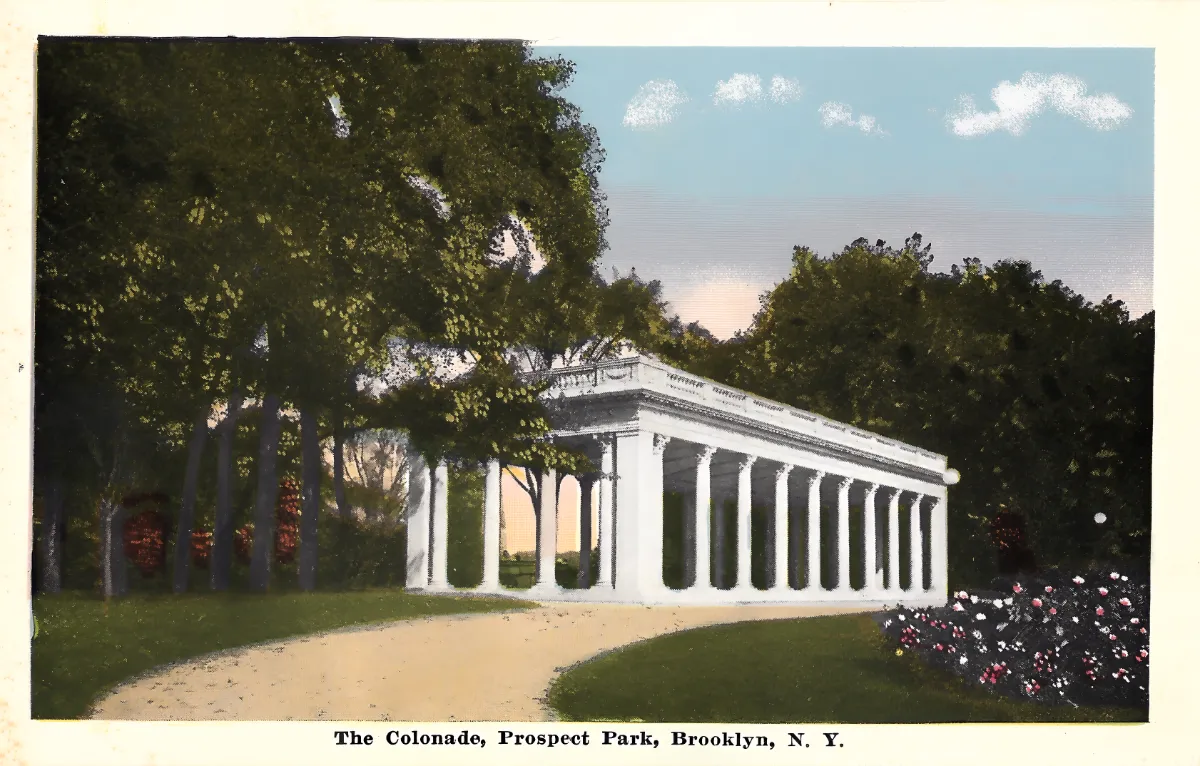
This antique postcard Prospect Park view shows the Colonnade, also known as the Peristyle or Grecian Shelter, a neoclassical marble structure standing near the park’s southern edge along Parkside Avenue in Brooklyn, New York. The hand-tinted image, a common production technique for many postcards printed in this period, centers on a curving gravel path that draws the eye toward a row of Corinthian columns supporting a terracotta entablature. Dense deciduous trees frame the structure on both sides, while a bed of pink and white rose bushes occupies the right foreground, a decorative planting choice consistent with the horticultural embellishments typical of the park’s formal areas at the time. The sky is rendered in a graduated wash from pale blue to soft pink tones near the horizon, suggesting either a late-afternoon setting or simply a stylistic convention meant to soften the overall tone of the printed view. Roughly twenty columns are visible in the illustrated perspective; the actual structure comprises twenty-eight Corinthian marble columns arranged in a rectangular colonnade atop a platform raised two steps above the surrounding lawn. No human figures appear in the scene, reinforcing the contemplative, landscape-oriented character common to postcard views of urban parks intended for tourists and residents alike wishing to showcase their city’s public amenities. The printed caption at the bottom of the card, “The Colonade, Prospect Park, Brooklyn, N. Y.”, spells “Colonnade” with a single n, a spelling variant found on several popular American postcard editions of the early twentieth century, though this alone does not identify a specific publisher.
Historical description:
The structure depicted on this card was built in 1905 by the architectural firm McKim, Mead & White, one of the most influential American practices at the turn of the twentieth century, also responsible for the Brooklyn Museum and several formal entrances within Prospect Park. Originally designated on early plans as a croquet shelter, this peristyle was part of a broader neoclassical improvement program undertaken from the mid-1890s onward to introduce more formal Beaux-Arts elements into the park’s original picturesque landscape design by Frederick Law Olmsted and Calvert Vaux. This information is drawn from documented external sources and is not a stylistic hypothesis. The platform itself is raised two steps above the surrounding lawn and carries twenty-eight Corinthian marble columns beneath a terracotta entablature, a level of architectural ambition uncommon among park structures of the earlier Olmsted and Vaux period. The precise printing date of the postcard itself, however, remains a hypothesis built from stylistic evidence: the white border framing the illustration corresponds to a printing convention widely adopted in the United States between approximately 1915 and 1930, when publishers standardized this white margin to reduce ink costs. Given the hand-tinted coloring and a rendering style still fairly close to earlier conventions, a dating toward the earlier part of this range, roughly 1915 to 1922, seems plausible, though not certain. Since the reverse of the card has not been provided, no analysis of the postmark, stamp, or any handwritten annotation could be performed, and the publisher’s identity along with the precise date therefore remain undetermined; confirmation would require examining the complete verso or consulting specialized catalogs of Brooklyn postcard publishers. In terms of social use, this antique postcard Prospect Park view fits within the widespread early-twentieth-century practice of sending scenic images of public parks as a record of an urban outing or as a tourist keepsake, with Prospect Park regarded, much like Manhattan’s Central Park, as a civic showcase for Brooklyn following its 1898 consolidation into New York City. The Colonnade was later designated a New York City individual landmark in 1968 and added to the National Register of Historic Places in 1972, reflecting the lasting architectural recognition granted to this structure long after the period of this antique postcard Prospect Park view.