Union County Courthouse in Elizabeth, New Jersey
Geographic description
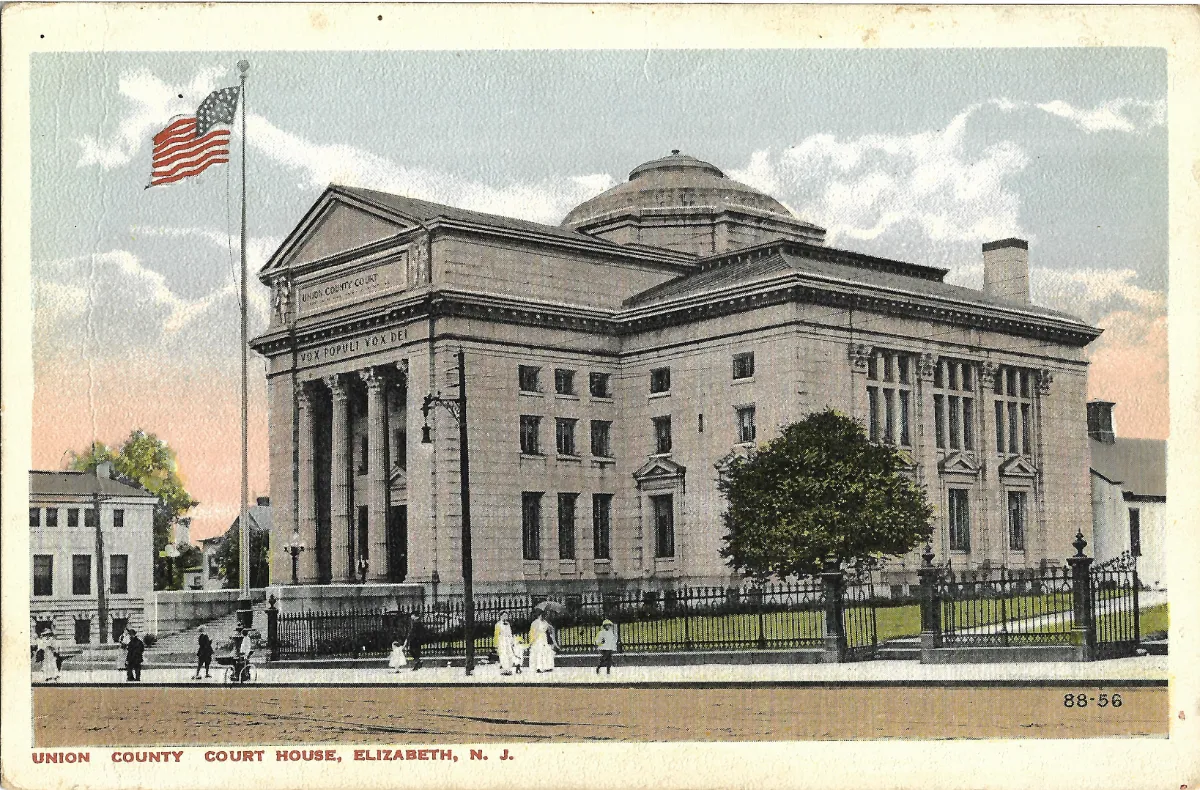
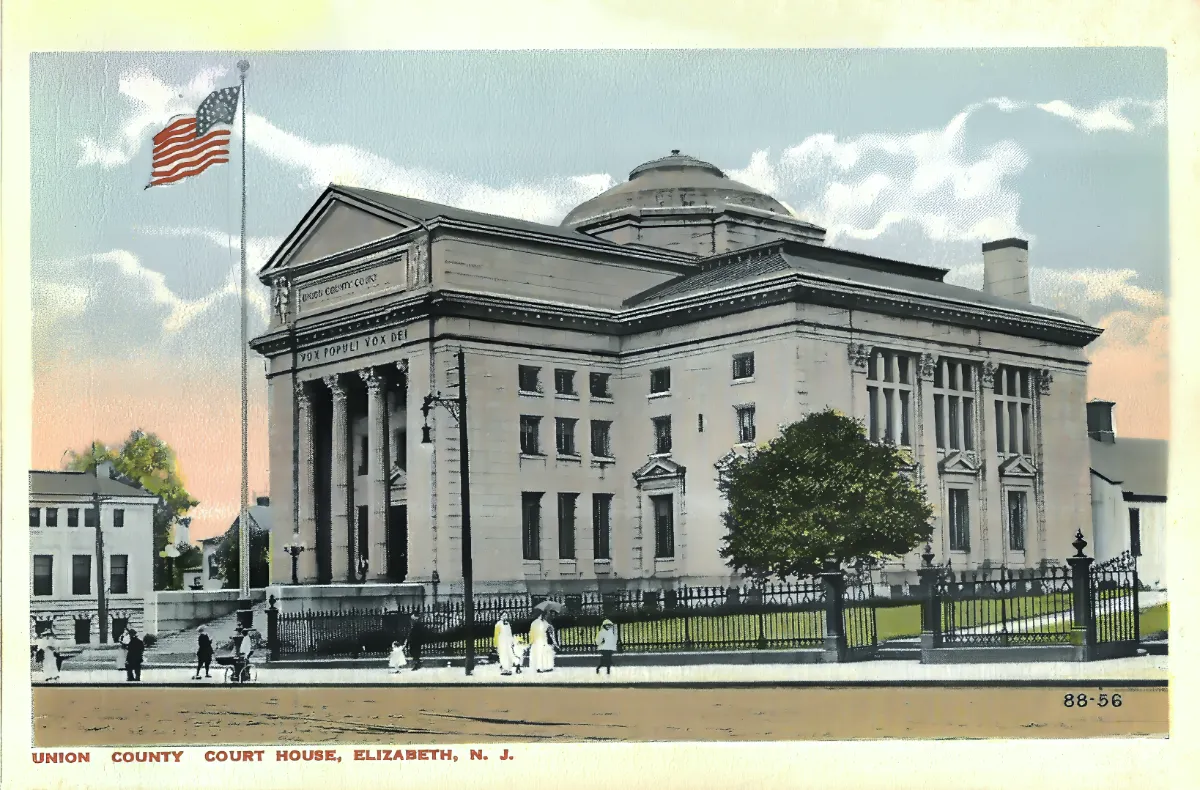
The Union County Courthouse in Elizabeth dominates this vintage postcard with its monumental Classical Revival architecture and prominent position in the city’s civic center. The caption printed along the lower edge, “Union County Court House, Elizabeth, N. J.,” identifies both the building and its location with certainty. Elizabeth is the county seat of Union County in northeastern New Jersey, and the historic courthouse stands at the corner of Broad Street and Rahway Avenue, within the present courthouse complex at 2 Broad Street.
The photograph was taken from an oblique viewpoint across the street, allowing both the main façade and one of the long side elevations to be seen. This perspective emphasizes the scale and formal symmetry of the building. A broad staircase leads to a monumental entrance portico supported by four Corinthian columns. Above the entrance is the Latin motto “Vox Populi Vox Dei”, commonly translated as “The voice of the people is the voice of God.” The words “Union County Court” can also be seen higher on the façade.
The architecture belongs to the Classical Revival tradition, a style frequently chosen for American civic and judicial buildings around the turn of the twentieth century. Classical columns, a prominent pediment, strong horizontal cornices and carefully balanced window openings were intended to communicate dignity, permanence and institutional authority. Historic documentation confirms that this section of the courthouse was designed by Ackerman & Ross.
A broad, low dome rises above the central portion of the roof. It corresponds to the courthouse’s interior rotunda, one of the building’s best-known architectural features. Upper-level corridors open toward this central space, creating a ceremonial core within the courthouse.
The postcard also preserves an unusually open view of the courthouse grounds. An ornamental iron fence separates the building from the sidewalk, while lawns and several trees soften the massive stone architecture. A tall flagpole stands prominently to the left of the entrance, carrying a large American flag.
A small number of pedestrians can be seen along the pavement and near the courthouse steps. Their scale makes the building appear even more imposing. No clearly identifiable automobile is present in the immediate foreground, and the street appears comparatively quiet. This uncluttered setting differs considerably from the denser urban environment that later developed around the courthouse complex.
The postcard is clearly hand-colored or mechanically colorized from a monochrome photograph. The pale blue sky, pinkish horizon, green lawns and bright American flag are characteristic of postcard production techniques intended to make photographic scenes more attractive. These colors should therefore be regarded as an artistic interpretation rather than precise evidence of the original appearance of the materials or landscape.
Historical description
The courthouse shown on this postcard represents an important phase in the administrative development of Elizabeth and Union County. Union County was created in 1857 from part of Essex County. As the population increased and county government expanded, the existing judicial facilities eventually became inadequate, leading officials to commission a substantially larger courthouse at the beginning of the twentieth century.
The architectural firm Ackerman & Ross designed the new building. Historical records and the courthouse’s construction tablet indicate that work began in February 1903 and was completed in April 1905. The three-story courthouse opened in 1905, providing accommodation for the county’s principal courts and government offices.
The postcard is particularly valuable because it appears to show the 1905 courthouse before the later additions dramatically altered the complex.
Union County continued to grow rapidly, and within roughly fifteen years the courthouse was already becoming too small. A substantial annex, including the Hall of Records and county jail, was added during the 1920s. The most dramatic transformation came in 1931, when a seventeen-story courthouse tower designed by Oakley and Son was completed. The new structure eventually became one of the defining features of the Elizabeth skyline.
That seventeen-story tower is entirely absent from this postcard. This provides an important chronological clue: the photograph itself must predate the completed 1931 tower. The relatively isolated appearance of the original courthouse also suggests that the photograph may predate the major expansion of the complex during the 1920s. A photographic date between 1905 and the mid-1920s therefore appears plausible.
The date of the postcard’s publication cannot be established with the same confidence. Postcard companies frequently reused older photographs for later printings. The colorized photographic style is consistent with American postcards issued during the first decades of the twentieth century, but this alone is not sufficient to assign a precise publication year. The number “88-56” printed at the lower right appears to be a publisher’s or series reference, although no publisher’s name is visible on the front and the number cannot safely be attributed to a particular company without further documentary evidence.
What makes this image especially significant is its presentation of the courthouse as a self-contained Classical Revival monument, before the much taller twentieth-century additions changed its proportions and surroundings. The postcard therefore records more than a single building: it captures an earlier stage in the development of Elizabeth’s civic center and reflects the growth of Union County government during the early twentieth century.
The historic 1905 structure survives as part of today’s courthouse complex, retaining its classical portico and interior rotunda. The courthouse is now associated with Elizabeth’s Mid-Town Historic District, which is recognized on both New Jersey and National Register listings.