Antique Postcard Woolworth Building, New York City
Geographic description:
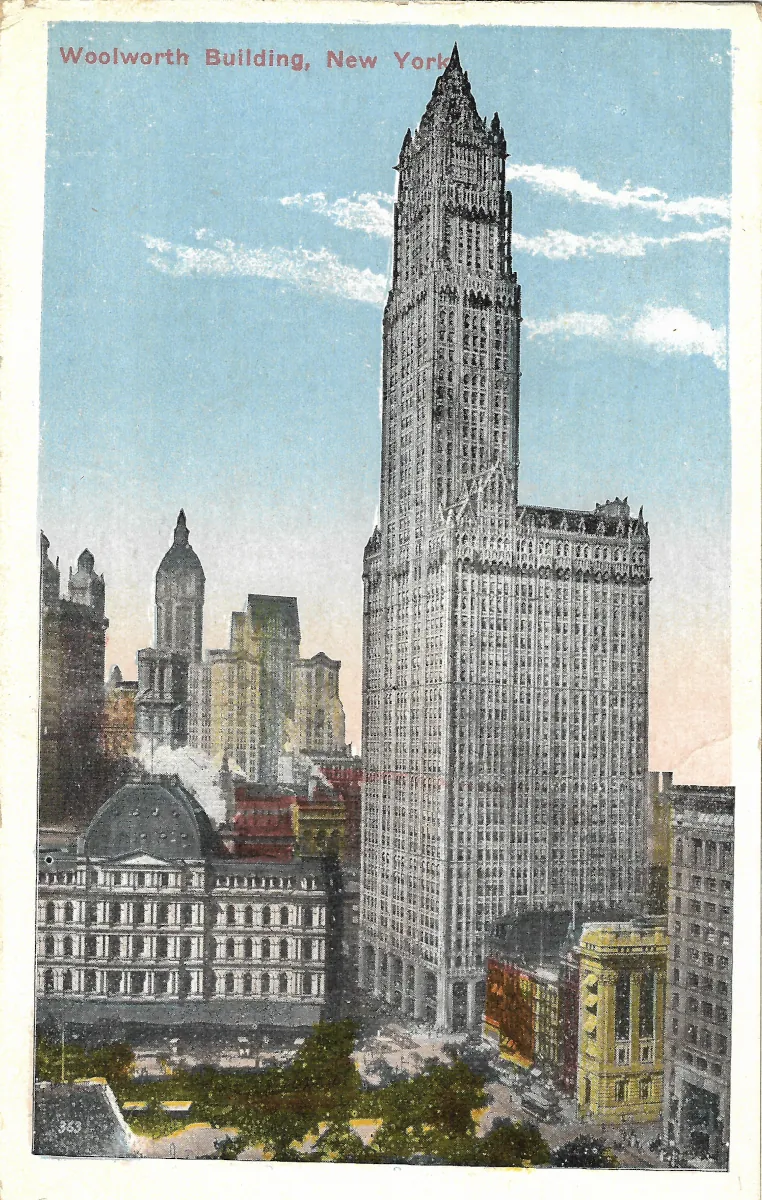
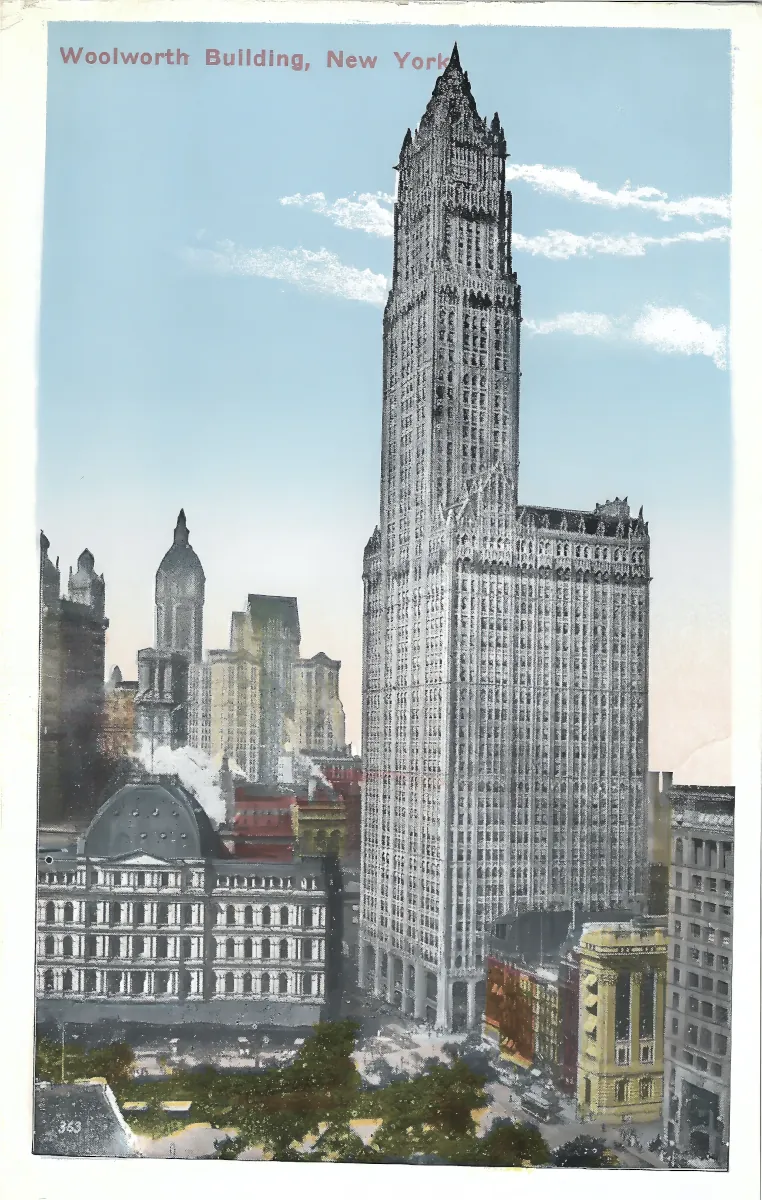
This antique postcard Woolworth Building offers an elevated view over Lower Manhattan, dominated in the foreground by the Woolworth Building rising far above its surrounding structures. The hand-colored photographic view highlights the slender silhouette of the tower, crowned with a neo-Gothic pinnacle featuring ornate finials, pierced gables, and a pyramidal spire reaching into a graded blue sky rendered with soft pink and white tones suggestive of early morning or late afternoon light. The terracotta façade, organized in a regular grid of windows, is rendered in light grey tones that contrast with the presumed verdigris patina of the metal ornamentation at the summit, though the card itself does not allow confirmation of the actual color beyond the colorist’s interpretation.
At the foot of the tower and to its left, a cluster of older, distinctly lower buildings can be seen: one structure with a dome and colonnaded façade whose general appearance plausibly evokes New York City Hall, though this cannot be stated with certainty since no textual element on the card confirms the identification. Just behind it, narrower towers topped with lanterns and small spires remain unidentified; they may correspond to office buildings from the Park Row or “Newspaper Row” district as it existed in the early twentieth century, but no legible signage allows a definitive naming. In the foreground to the right, a building with a yellow terracotta façade stands out for its arched openings and richer decorative treatment compared to neighboring structures; its precise identity likewise remains undetermined.
At street level, a row of trees is visible, along with the silhouettes of several small motor vehicles and what may be streetcars or omnibuses, though these are difficult to identify with certainty given the image’s resolution at this scale. This presence of motorized vehicles, combined with the apparent absence of horse-drawn carriages, provides a dating clue that will be developed further in the historical section. In the lower left corner of the card, an edition number, “363,” appears, likely a series number assigned by the card’s publisher, whose name is not visible on this side.
Historical description:
The Woolworth Building, completed in 1913, was designed by architect Cass Gilbert for Frank W. Woolworth, founder of the five-and-dime retail chain. Standing 241 meters tall, it held the title of tallest building in the world until the completion of the Chrysler Building in 1930, and its neo-Gothic crown, inspired by European cathedrals, earned it the nickname “Cathedral of Commerce.” The fact that this antique postcard Woolworth Building shows a tower that appears fully completed and integrated into the surrounding skyline indicates that the underlying photograph must postdate 1913; this constitutes a firm chronological anchor point.
Beyond this lower bound, more precise dating remains hypothetical in the absence of a verso image: no postmark, stamp, or handwritten note is available for examination, which leaves any claim about the card’s actual mailing date undetermined. The analysis must therefore rely solely on internal visual evidence. The colorized treatment of the sky, with its soft gradients and stylized clouds, corresponds to a hand-tinting or semi-mechanical coloring technique widely used in American postcard publishing between roughly 1900 and 1930; on its own, however, this does not narrow the dating range any further.
A more discriminating clue lies in the presence of small motor vehicles at street level, with no identifiable horse-drawn transport: this suggests a probable dating somewhere between the mid-1910s and the early 1920s, a period during which automobiles rapidly displaced horse-drawn vehicles on the streets of Manhattan. This hypothesis, however, carries only moderate confidence, as the image’s resolution does not allow certain identification of vehicle models.
The number “363” visible in the lower left corner likely corresponds to a series or catalog number assigned by the card’s publisher; in the absence of a visible publisher name on the recto, and without a verso available for verification, this detail remains undetermined and would require external confirmation, for instance through archives specializing in New York postcard collecting. Similarly, the identification of the domed building to the left of the composition as New York City Hall, while plausible given its likely geographic position near City Hall Park, cannot be considered certain without further comparative evidence.
From a publishing standpoint, this card belongs to a broader phenomenon of producing urban view postcards of major American cities for tourism and commercial purposes, intended to be sent by visitors to New York to friends and family back home. The choice of the Woolworth Building as the central subject reflects the iconic status this skyscraper held in the early twentieth-century popular imagination, as a symbol of American economic power and architectural innovation.