Marseille – 1922 Colonial Exhibition: Angkor Wat and the Sacred Lake
Geographic description
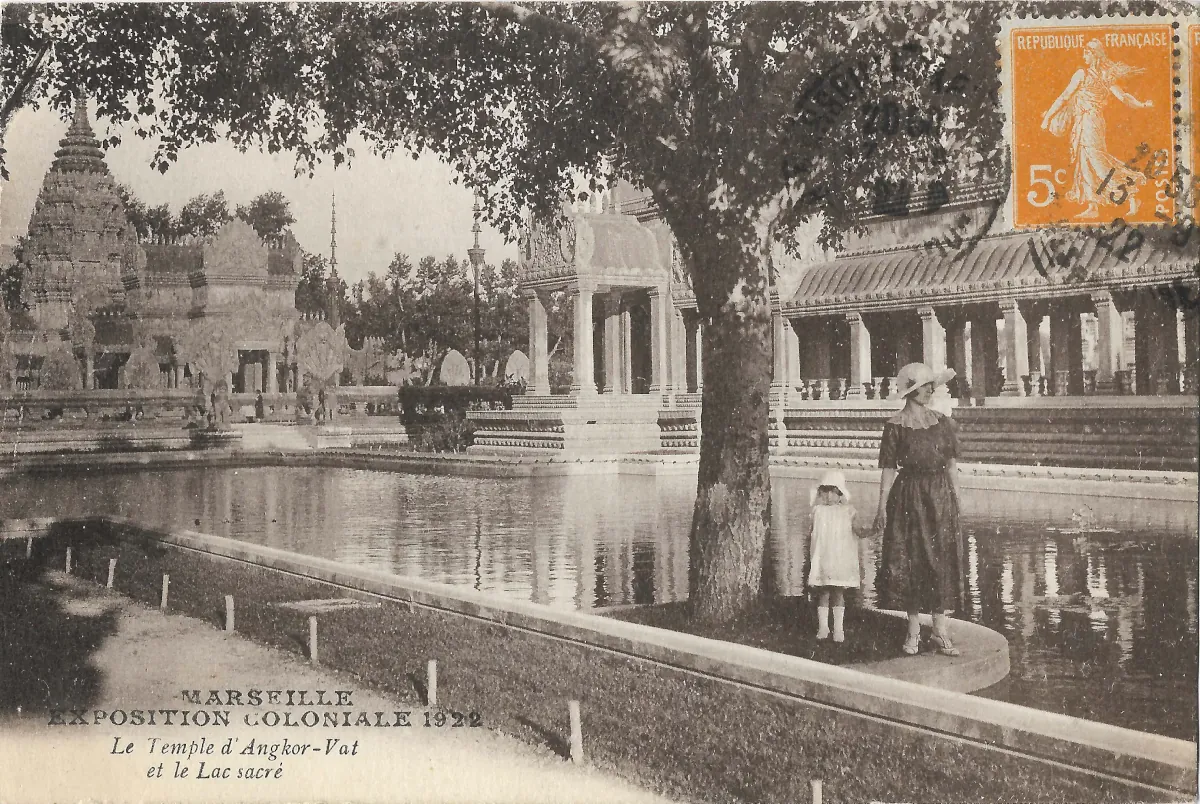
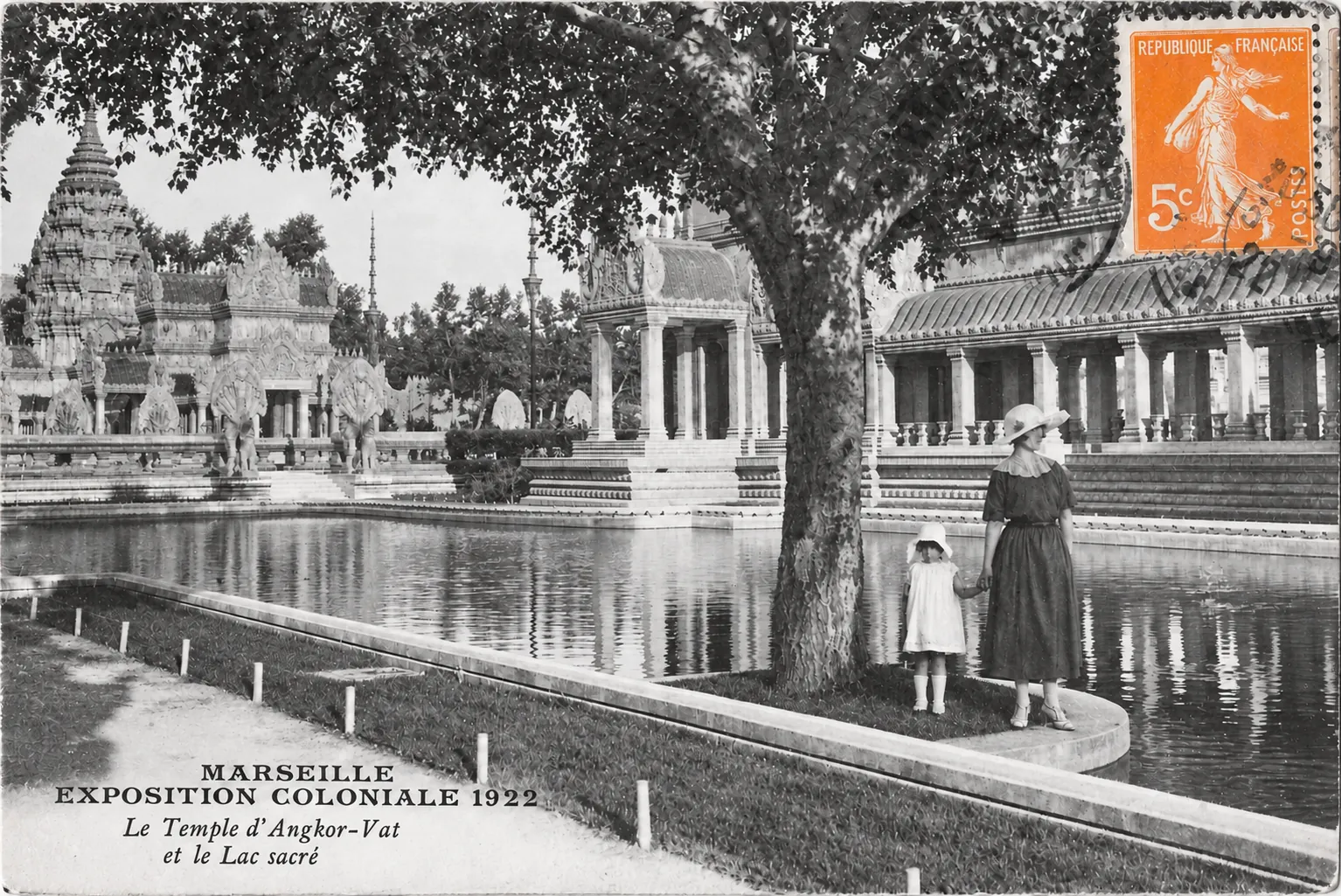
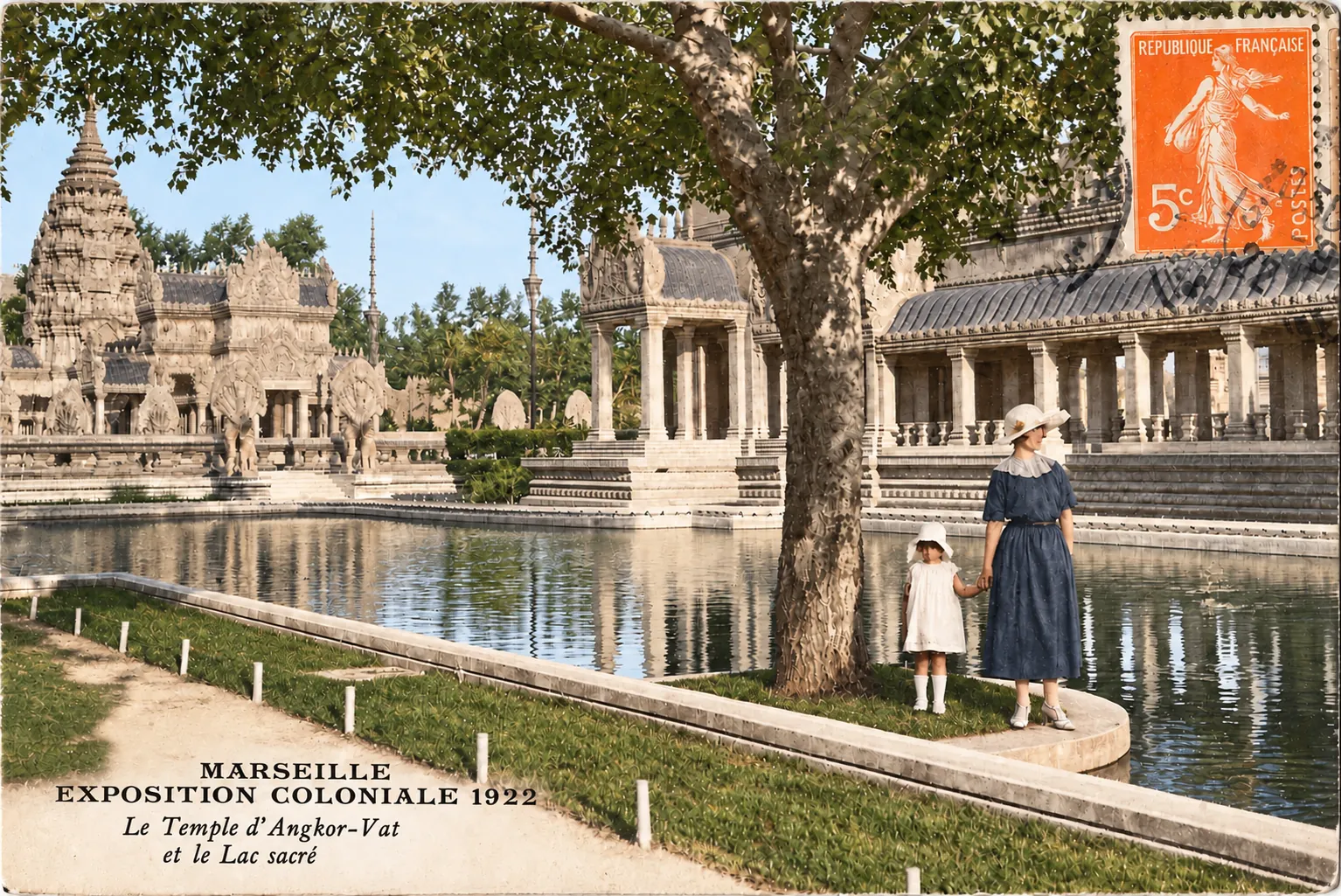
The Marseille Colonial Exhibition 1922 is shown here through one of its most striking architectural settings: an evocation of Angkor Wat and its surrounding Khmer-inspired architecture, arranged around a large ornamental pool identified on the postcard as the “Sacred Lake.” The printed caption clearly identifies Marseille, the 1922 exhibition and the subject of the photograph.
A broad sheet of water dominates the foreground. Its calm surface reflects the exhibition buildings and enhances the monumental character of the scene. A large tree near the centre divides the composition between the architectural ensemble and two visitors, a woman and a young child standing beside the water.
On the left, a tall tiered tower immediately recalls the forms associated with the temples of Angkor. Beyond it are several elaborately decorated structures featuring slender towers, sculptural details and complex rooflines intended to evoke Cambodian architecture. In the centre stands an open pavilion supported by columns, while a long colonnaded gallery extends across the right-hand side of the photograph.
The buildings should not be mistaken for the actual temple of Angkor Wat in Cambodia. They formed part of an exhibition reconstruction or architectural interpretation created in Marseille. Colonial exhibitions frequently used recognizable architectural motifs and replicas of celebrated monuments to provide visitors with an impressive visual representation of distant territories.
The pool was an important part of this carefully designed setting. Together with the paths, lawns and mature trees, it created the appearance of a landscaped monumental garden. The photographer selected a viewpoint from beneath the vegetation, allowing the architecture to appear through the foliage while its reflection remains visible in the water.
The two visitors provide an effective indication of scale. The woman wears a dark calf-length dress and a broad-brimmed hat typical of the early 1920s, while the child beside her is dressed in light clothing and a small hat. Their relatively small figures emphasize the dimensions of the exhibition structures behind them.
The scene therefore combines architecture, landscape design and human presence. Rather than documenting an ordinary Marseille street, the postcard records a deliberately constructed environment intended to impress visitors and transport them symbolically to another part of the world.
Its geographical setting is nevertheless firmly Marseille. The Angkor-inspired buildings belonged to a temporary exhibition landscape created within the city, demonstrating how an architectural image associated with Cambodia could be recreated thousands of kilometres away and presented to a European public as one of the major attractions of a colonial exhibition.
Historical description
The Marseille Colonial Exhibition of 1922 belonged to an era when large international and colonial exhibitions were important instruments for presenting France’s overseas empire to the metropolitan public. Marseille was a particularly significant location for such an event because of its role as a major Mediterranean port and its longstanding maritime and commercial connections with North Africa, sub-Saharan Africa and Asia.
The city had already hosted a major colonial exhibition in 1906. The 1922 event continued this tradition after the First World War, at a time when French authorities placed considerable emphasis on displaying the extent, resources and perceived importance of the colonial empire.
Exhibition grounds of this kind combined architecture, commercial displays, craft production, entertainment and representations of the peoples and cultures of territories under French rule. Elaborate temporary buildings were essential to the spectacle, allowing visitors to move through a succession of environments designed to evoke different regions.
Cambodia was then incorporated into French Indochina, and the monuments of Angkor had already acquired enormous symbolic importance in European representations of the region. Angkor Wat in particular had become an instantly recognizable image through photography, publications, posters and postcards.
The caption “Le Temple d’Angkor-Vat et le Lac sacré” therefore refers to an exhibition representation of the monument rather than to the original Cambodian temple. The distinction is historically important. The structures visible on the postcard reveal not only an interest in Khmer architecture, but also the way colonial France chose to present Cambodia and its monuments to a French audience.
Such displays were intended to be spectacular and accessible. Visitors could encounter architectural forms inspired by distant regions without leaving Marseille, moving through gardens, pavilions and reconstructed settings within a single exhibition ground. The ornamental lake and Angkor-inspired buildings formed part of this carefully staged experience.
From a modern historical perspective, colonial exhibitions must also be considered within the political system that produced them. Their representations were not neutral accounts of the societies concerned. They reflected colonial attitudes, institutional priorities and unequal relationships of power while promoting an idealized image of the French empire.
Postcards played an important part in extending the influence of these exhibitions. Visitors could purchase inexpensive photographic views, send them throughout France or abroad, and preserve them as souvenirs. In this way, images of the exhibition circulated far beyond the people who had actually visited Marseille.
The surviving 5-cent French postage stamp in the upper-right corner adds another documentary element to the card. Together with the printed identification of the exhibition, it reinforces its character as an object produced for contemporary circulation rather than a later reproduction.
Dating is unusually straightforward in this case because 1922 appears directly in the printed caption. The clothing visible in the photograph and the style of the postcard are also consistent with the early 1920s. The image is therefore both a souvenir of a major Marseille event and a revealing historical document illustrating how Angkor and Cambodia were represented to French audiences during the colonial period.