Marseille 1922 Colonial Exhibition – Annamite Pagoda on the Water
Geographic description
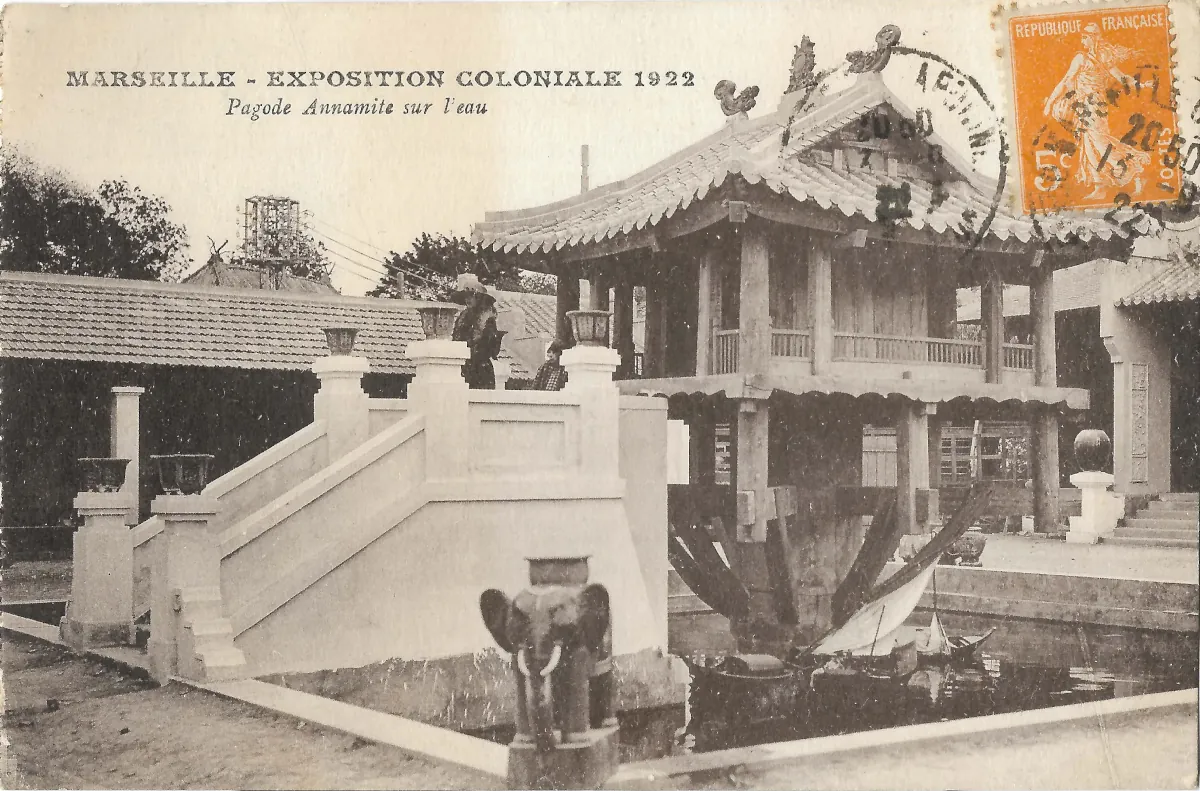
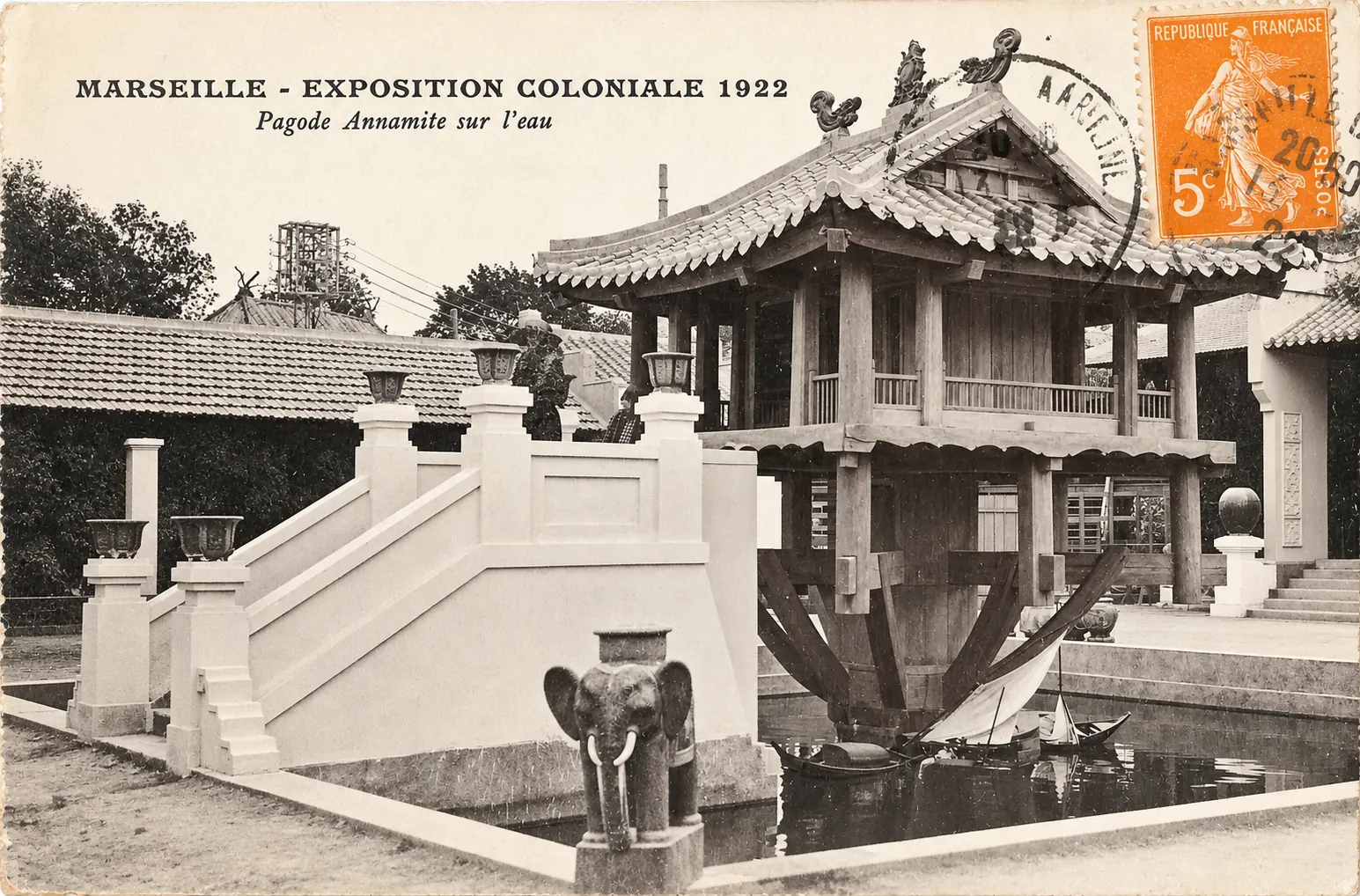
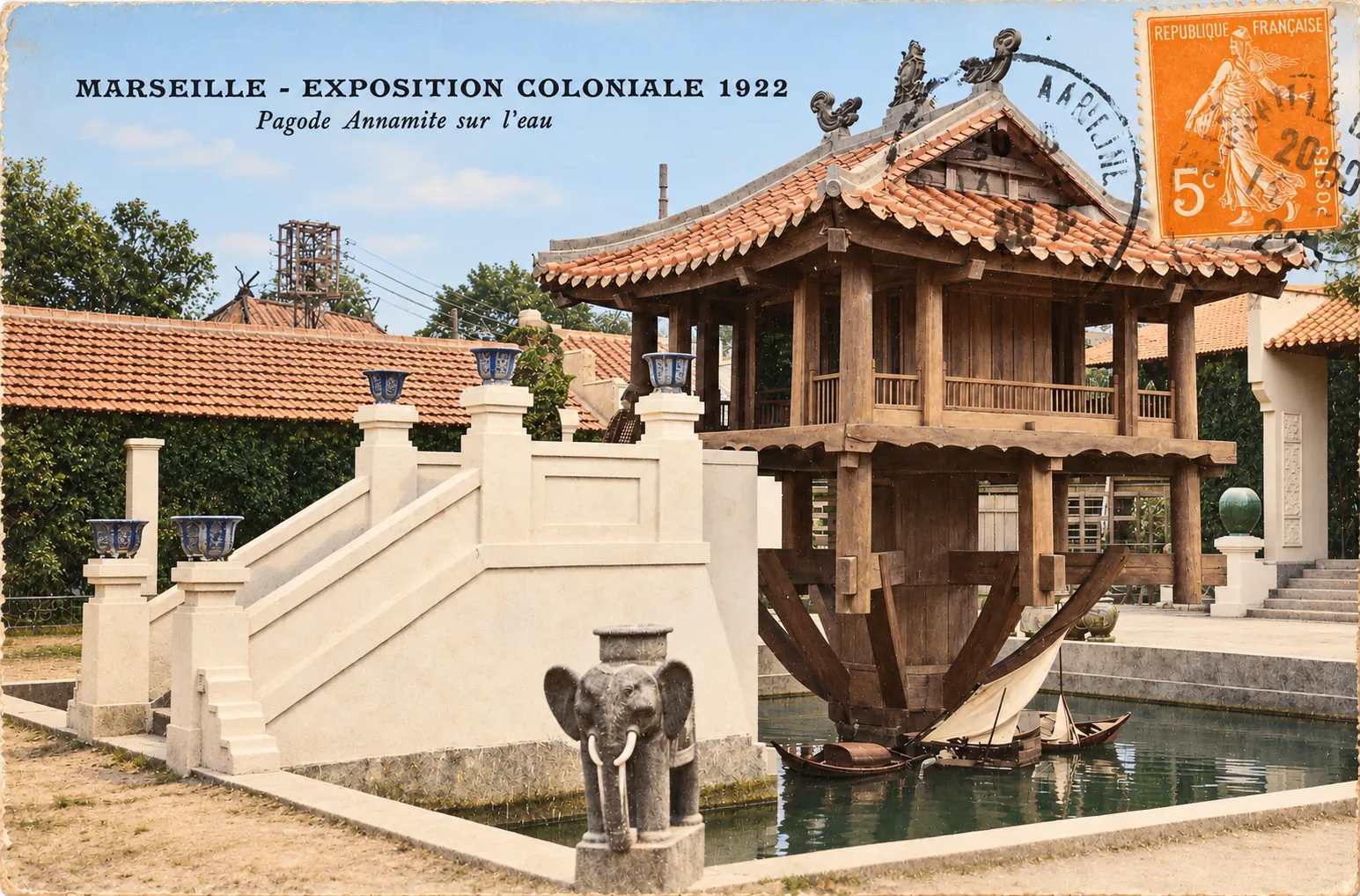
The Annamite Pagoda Marseille 1922 postcard shows one of the architectural displays created for the Colonial Exhibition held in Marseille, with the pavilion carefully staged beside and above an ornamental pool. The printed caption, “Marseille – Exposition Coloniale 1922 – Pagode Annamite sur l’eau,” clearly identifies both the subject and the event.
The pavilion dominates the centre of the scene. Its architecture draws on Vietnamese forms, with a broad tiled roof, projecting eaves and decorative upward-curving roof ornaments. An open gallery protected by a balustrade surrounds part of the upper structure, while the building itself is raised above the water.
A substantial staircase on the left leads towards the pavilion. Its pale rendered walls contrast strongly with the darker wooden architectural elements. Decorative pillars mark the stairway and terrace, reinforcing the theatrical character of the setting. The entire composition appears to have been designed to provide exhibition visitors with an immediately picturesque view rather than to reproduce a particular Vietnamese religious monument with archaeological precision.
Water plays an important part in the design. Several small boats can be seen beside the pavilion, including one with a profile intended to suggest a traditional Asian craft. An elephant figure also stands prominently in the foreground. Together with the curved roofs and surrounding ornamental features, these elements created the exotic visual atmosphere commonly associated with colonial exhibitions of the period.
Additional buildings can be seen behind the main pavilion. A tall framework or tower rises in the distance, although its exact purpose cannot be established from the postcard alone. These background structures demonstrate that the pagoda formed part of a much larger exhibition complex composed of temporary pavilions, landscaped areas and architectural reconstructions.
The word “pagoda” should therefore be understood primarily as the contemporary designation printed on the postcard. The photograph clearly shows an Asian-inspired pavilion above the water, but the image alone does not establish that the structure functioned as a consecrated religious building.
Historical description
This postcard belongs to the context of the 1922 Marseille Colonial Exhibition, one of the major French exhibitions devoted to the territories then governed or controlled by France.
Marseille had especially strong connections with the French colonial world. Its Mediterranean port handled large flows of passengers, raw materials and commercial goods travelling between metropolitan France, North Africa, the eastern Mediterranean, the Indian Ocean and French Indochina. Holding a major colonial exhibition in Marseille therefore had important economic and political significance as well as considerable popular appeal.
The adjective “Annamite” refers to Annam, the historical colonial name used primarily for the central region of present-day Vietnam. During this period, Annam formed part of French Indochina together with other territories including Tonkin, Cochinchina, Cambodia and Laos.
“Annamite” was normal French administrative and popular vocabulary in the early twentieth century but is now chiefly a historical term associated with the colonial period. Its use here reflects the original wording of the postcard and the terminology of the 1922 exhibition rather than modern geographical usage.
Buildings such as this pavilion were intended to do more than display architectural styles. Colonial exhibitions presented overseas territories through reconstructed buildings, landscaped settings, agricultural and manufactured products, decorative arts and various displays intended for a metropolitan audience. These representations were shaped by the political and cultural viewpoint of the colonial authorities and often emphasized visual difference and exoticism.
The so-called Annamite Pagoda on the Water illustrates this approach particularly well. Its combination of an ornamental pool, traditional-looking boats, an elephant figure and distinctly Asian roof forms created a highly picturesque scene. Such views were especially suitable for postcard publishers, who could transform exhibition architecture into inexpensive souvenirs distributed throughout France and beyond.
The postcard itself provides additional evidence of its use as a genuine piece of correspondence. A five-centime French postage stamp remains attached in the upper-right corner and is covered by a partially visible cancellation. The surviving portion of the postmark is not sufficiently clear to establish a precise mailing date from the image alone. Nevertheless, its presence confirms that the postcard circulated through the postal system rather than surviving solely as an unused souvenir.
The photograph is therefore valuable on several levels. It records a temporary structure from an event that has largely disappeared from the urban landscape, illustrates the enormous popularity of picture postcards during the early twentieth century, and documents the way French Indochina and Vietnam were represented to metropolitan audiences during the colonial era.
Today, the scene can be read both as an attractive example of early twentieth-century exhibition architecture and as a historical document reflecting the political and cultural assumptions of its time. The postcard preserves not only the appearance of a vanished pavilion but also the visual language through which colonial exhibitions attempted to present distant territories to the French public.