Marseille – Château d’If Seen from the Sea
Geographic description
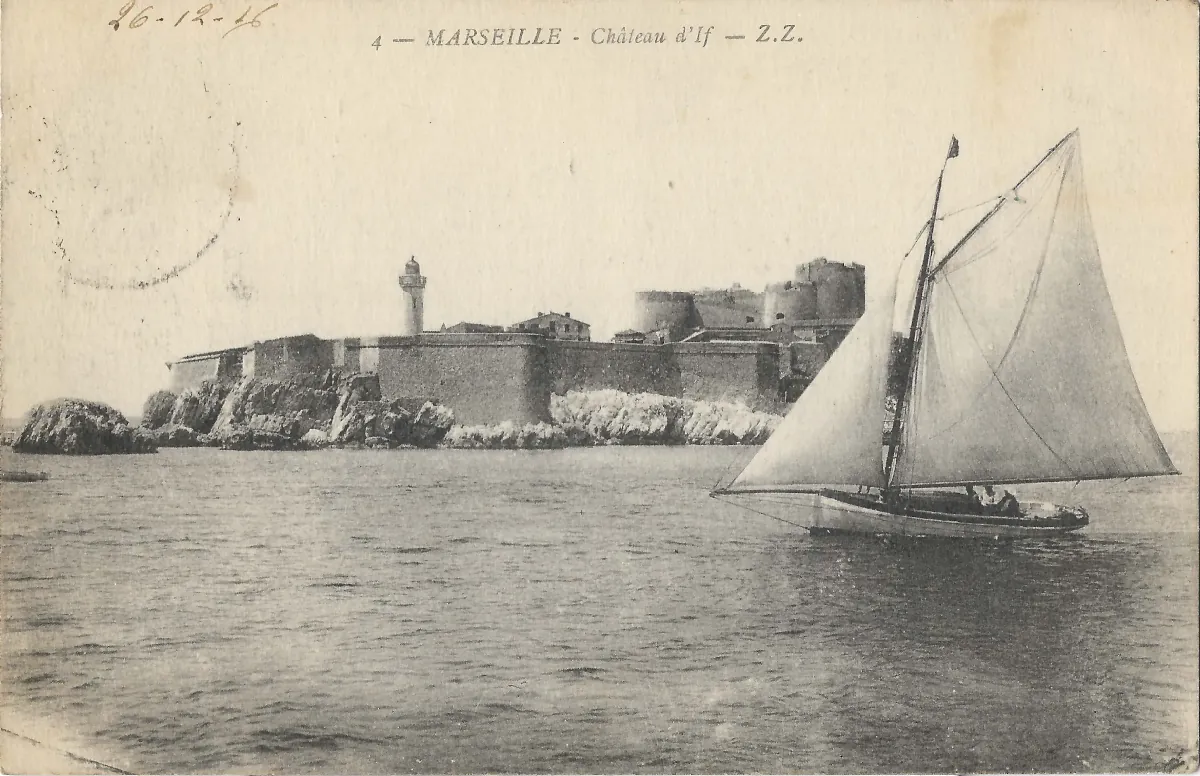
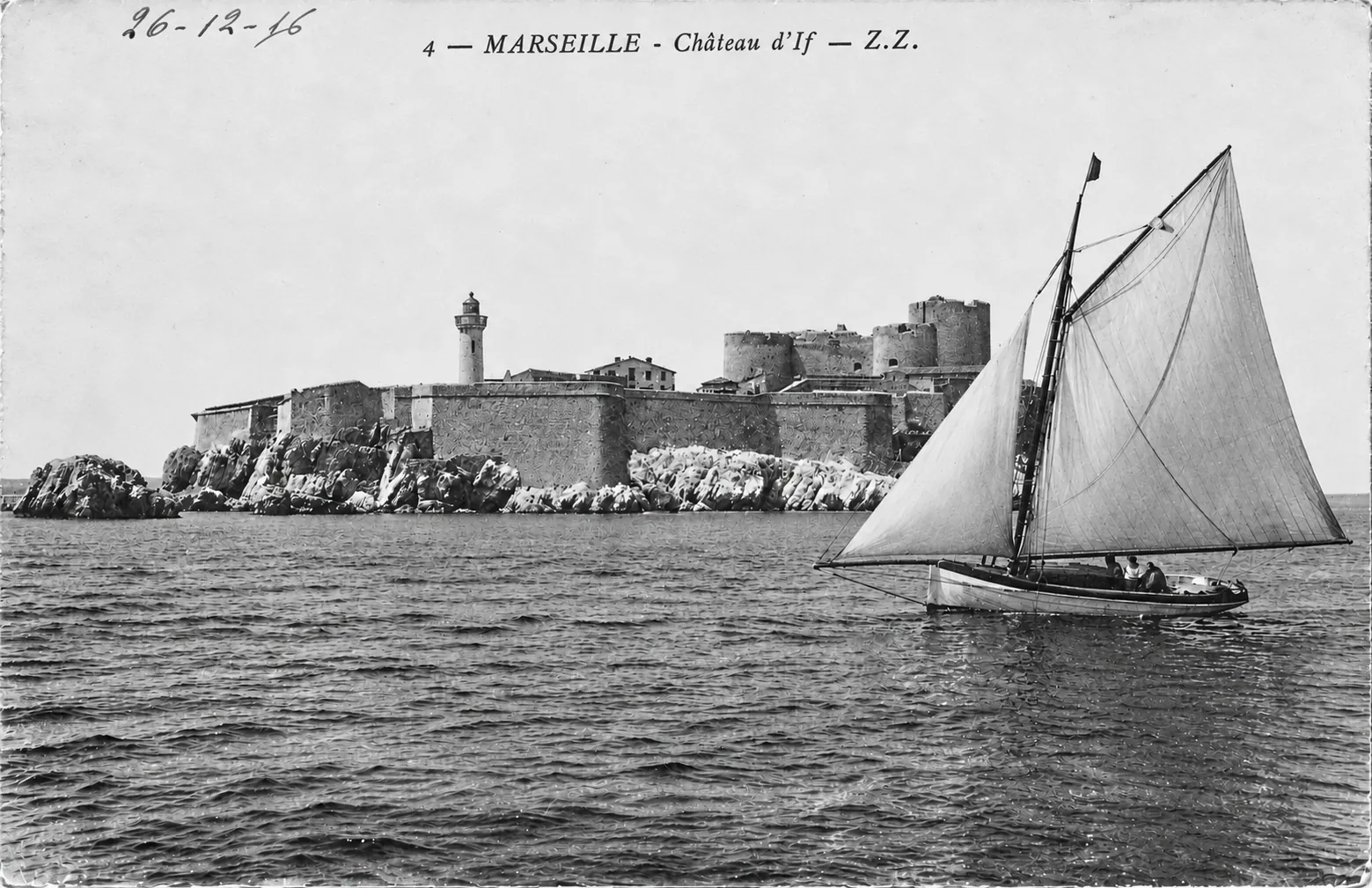
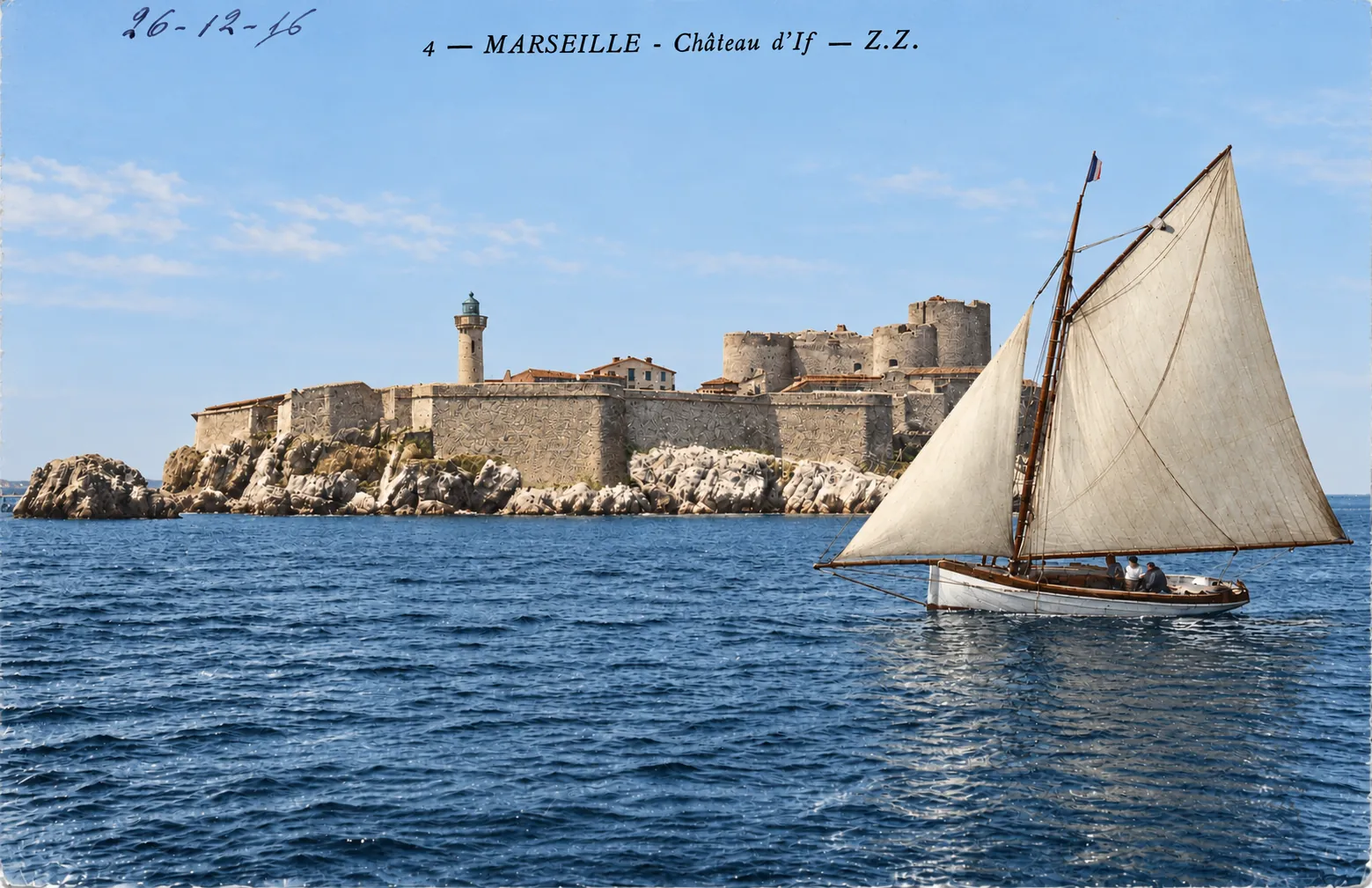
The Château d’If in Marseille stands on the small rocky Île d’If, just offshore from the city and close to the Frioul archipelago. This old postcard presents a particularly evocative maritime view of the site, with the fortress dominating the background while a traditional sailing boat crosses the foreground under full sail.
The island appears as a low, rugged mass of rock almost entirely occupied by defensive structures. Heavy walls follow the natural contours of the shoreline, rising directly above the Mediterranean. On the higher part of the island stands the main body of the Château d’If, recognizable by its massive architecture and rounded towers. The compact appearance of the complex clearly reflects its original defensive purpose and its strategic position on the maritime approaches to Marseille.
To the left of the fortress, a lighthouse rises above the lower buildings and ramparts. Its slender vertical silhouette contrasts strongly with the broad horizontal mass of the castle and recalls the importance of the island as a landmark for vessels approaching Marseille.
The sailing boat on the right provides the most dynamic element of the photograph. It is a traditional single-masted craft carrying a large triangular sail and a forward sail, with several people apparently aboard. Rather than serving merely as a decorative feature, the vessel evokes the maritime activity that once surrounded Marseille, where fishing boats, coastal craft and other small sailing vessels regularly shared the waters near the harbour.
The photograph was taken from the sea at some distance from the island. This viewpoint emphasizes the isolated character of the Château d’If. No part of the Marseille shoreline is visible behind it, leaving the fortress apparently surrounded by open water. The sea occupies almost the entire lower half of the composition, creating a strong visual separation between the viewer and the island.
The printed caption at the top reads “4 – MARSEILLE – Château d’If – Z.Z.”. The number 4 was probably an internal reference within a postcard series devoted to Marseille or its surroundings. The initials “Z.Z.” are also printed alongside the title, although they are not sufficient on their own to identify the publisher with certainty.
A handwritten inscription in the upper-left corner appears to read “26-12-26”. If this reading is correct, it would indicate 26 December 1926 and provide a valuable clue to the period when this particular postcard was used. It should not, however, be regarded as the exact date of the photograph or publication, since postcards often remained in circulation for several years.
Historical description
The Château d’If is one of Marseille’s best-known historic landmarks. The fortress was constructed during the reign of Francis I in the 16th century as part of the defensive system protecting the city and its harbour. The small island offered a strategic position from which the maritime approaches to Marseille could be controlled.
The castle was designed as a compact fortified complex, with a central structure reinforced by towers and surrounded by defensive walls. Although its military importance proved less decisive than its imposing architecture might suggest, the isolated location and strong construction soon made the site suitable for another purpose: imprisonment.
For several centuries, the Château d’If served as a prison and held various categories of detainees, including political and religious prisoners. This use contributed considerably to the fortress’s reputation as an isolated and forbidding place.
Its worldwide fame, however, owes much to literature. In The Count of Monte Cristo, Alexandre Dumas has his fictional hero Edmond Dantès imprisoned in the Château d’If. Dantès and his dramatic escape are fictional, but the novel permanently associated the real fortress with the image of an inaccessible Mediterranean prison. This literary connection later became an important part of the monument’s appeal to visitors.
The postcard itself most probably belongs to the early decades of the 20th century. Its monochrome printing, typography, photographic composition and traditional sailing vessel are all consistent with postcard production from that period. The handwritten date apparently reading 26 December 1926 provides additional support for the conclusion that this particular copy was in circulation during the 1920s.
By that time Marseille was already one of the major ports of the Mediterranean. Images of the Château d’If were therefore especially suitable for postcards, combining several elements closely associated with the city: the Mediterranean Sea, sailing vessels, coastal fortifications and the approaches to its famous harbour.
The photograph is also valuable as a record of the monument before modern visitor facilities became part of the surrounding landscape. The fortress dominates the bare rocky island, while the sailing boat reinforces the traditional maritime atmosphere of the scene.
The composition gains much of its strength from the contrast between the two principal subjects. The Château d’If appears massive, immovable and severe, while the sailing boat is light and mobile, driven across the water by the wind. The result is more than a straightforward architectural record: it is also a vivid image of the maritime identity that has shaped Marseille and its coastal landscape for centuries.